SF BAY AREA PERSONAL INJURY LAWYER
Built for serious cases and real results





A traumatic brain injury, including a mild TBI or concussion, can happen after a car crash, slip and fall, bicycle collision, pedestrian accident, workplace incident, or other sudden impact. Many people do not realize they may have a brain injury right away. They may walk away from the scene, speak normally, and even think they are fine. Then, hours or days later, they begin to notice headaches, dizziness, memory problems, confusion, sensitivity to light, sleep changes, or unusual irritability. Mild TBIs are often described as “mild” because they are usually not life-threatening at the outset, but the symptoms and long-term effects can still be serious.
At Anderson Franco Law, we created this resource because brain injury cases are often under-documented early. Insurance companies may try to minimize these claims, especially when imaging is normal or when the injured person delayed treatment. A strong traumatic brain injury claim usually depends on careful symptom tracking, consistent medical treatment, and clear documentation showing how the injury affected daily life, work, memory, concentration, and relationships. This questionnaire is designed to help you organize that information after an accident in California.
Traumatic brain injury symptoms are often missed because they are not always obvious at the scene. A person may be focused on other pain, shock, vehicle damage, or getting home safely. Some symptoms do not appear immediately. Others seem vague at first, such as fatigue, brain fog, trouble concentrating, mood changes, or sleep disruption. Medical authorities recognize that concussion symptoms can be subtle and may not occur right away, and some brain changes from mild TBI may not appear on a standard CT scan.
That is one reason brain injury cases are frequently misunderstood. Someone may look normal to family, coworkers, or an insurance adjuster while still dealing with a very real injury. In personal injury cases, this delay can create problems if the person never reports the symptoms, never follows up with a doctor, or waits too long to connect those symptoms to the crash or fall.
Common symptoms after a concussion or mild traumatic brain injury can include headache, dizziness, balance problems, nausea, vomiting, blurry vision, fatigue, sensitivity to light or noise, confusion, memory trouble, feeling slowed down, trouble concentrating, irritability, emotional changes, and sleep disturbance. Some people also describe feeling foggy, groggy, detached, or unlike themselves.
These symptoms matter in a California personal injury claim because they can affect far more than emergency room bills. A brain injury may interfere with work performance, child care, driving, school, communication, household tasks, and emotional stability. The claim is not only about the diagnosis. It is also about how the injury changed the person’s daily functioning.
Seek emergency medical care right away after a head injury or body trauma with suspected brain injury if you have danger signs such as a headache that gets worse and does not go away, repeated vomiting, seizures, weakness, numbness, reduced coordination, slurred speech, unusual behavior, increasing confusion, inability to recognize people or places, one pupil larger than the other, loss of consciousness, extreme drowsiness, or difficulty waking up. Major medical sources also advise emergency evaluation when there are concerning symptoms or behavioral changes after a recent blow to the head or body.
Even when symptoms do not seem emergent, it is still wise to get medical evaluation promptly if you suspect a concussion or traumatic brain injury. Early medical records often become important evidence later.
Brain injury claims often turn on documentation. In many cases, there is no dramatic photograph that tells the full story. Instead, the evidence develops through medical records, symptom logs, witness observations, employment records, and consistent reporting over time. If symptoms are recorded early and repeatedly, it becomes easier to show that the injury was real, that it followed the accident, and that it affected normal life in a meaningful way.
Lawyers matter because personal injury claims are built with evidence, not just symptoms. A lawyer can help connect the accident facts, medical timeline, witness statements, and functional impact into a claim that insurance companies and defense lawyers must take seriously. Lawyers also help identify whether additional proof may be needed, such as neurology records, neuropsychological testing, treating provider opinions, imaging review, or testimony from family members and coworkers who noticed the change after the incident.
In California, timing matters too. In many cases, the general statute of limitations for injury claims is two years, though shorter deadlines can apply in some situations, especially when a public entity is involved.
A good traumatic brain injury questionnaire helps in several ways.
First, it helps capture symptoms that are easy to forget later. Many people remember the headache but forget the sleep disruption, word-finding issues, irritability, missed appointments, or trouble finishing simple tasks.
Second, it creates a timeline. In a personal injury case, timing matters. When did symptoms begin? Did they worsen over 24 hours? Did they continue for weeks? Did the injured person miss work, stop driving, or need help at home?
Third, it helps show functional loss. Insurance carriers often focus on imaging and diagnosis labels. But the real-world impact of a brain injury often shows up in everyday life: inability to concentrate, memory lapses, emotional changes, reduced stamina, and interrupted work or parenting.
Fourth, it helps your lawyer and medical providers ask better questions. A written checklist can reveal patterns that may otherwise be missed during a brief office visit.
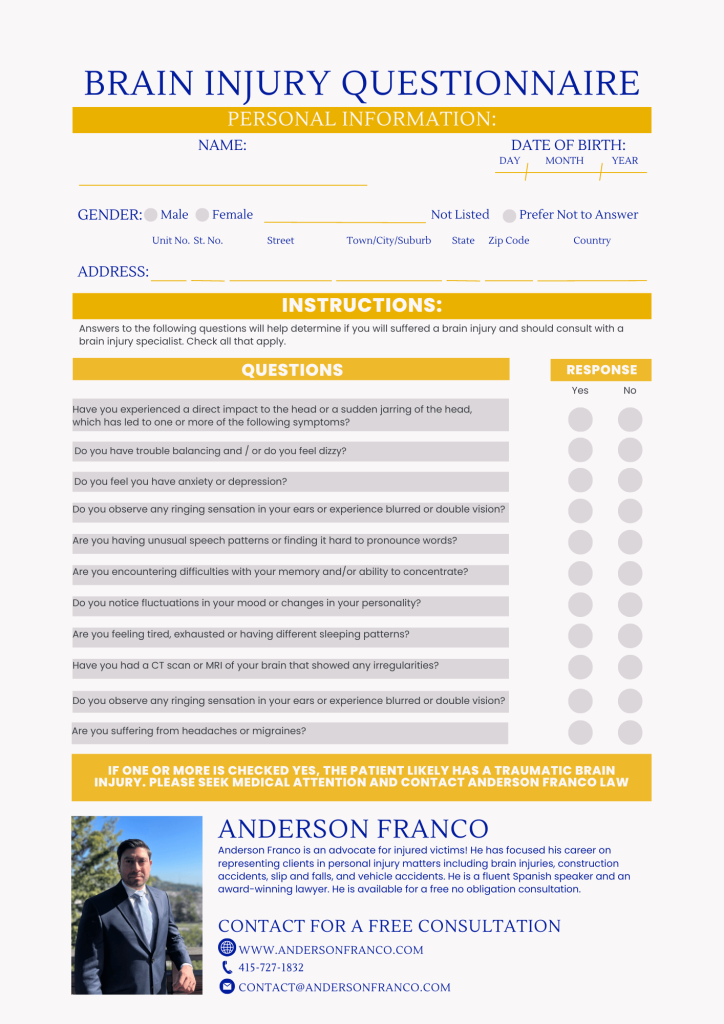
You mentioned the page will already include your questionnaire. Below is text you can place directly on the page as a companion checklist above or below the downloadable form.
Check any symptoms you noticed at the scene or shortly after:
Check any symptoms that started hours or days after the accident:
Since the accident, have you had problems with:
Describe the biggest changes in your daily life:
Has anyone noticed changes in you since the accident?
What changes have they noticed?
Rate each from 0 to 10:
How often do symptoms occur?
What makes symptoms worse?
Complete the questionnaire as soon as possible after the accident. Update it if new symptoms appear. Bring it to medical appointments. Share it with your lawyer. Keep copies of discharge papers, urgent care records, prescriptions, work notes, and messages with insurers. The more consistent the record, the more useful it becomes in proving the claim.
A traumatic brain injury claim can be undervalued when the injured person “looks fine,” imaging is normal, or symptoms develop gradually. That is exactly why careful documentation matters. A thorough questionnaire helps preserve the story of the injury before details fade. It also helps connect the accident to the symptoms, and the symptoms to the real losses the person experienced.
At Anderson Franco Law, we use documentation like this to better understand what a client is dealing with and to present brain injury claims with the detail they deserve. A well-documented case is usually stronger than a case built on vague memory months later.
If you believe you may have suffered a traumatic brain injury after an accident in California, do not ignore the symptoms. Get medical attention, document what you are experiencing, and take the injury seriously. If you want to discuss a possible personal injury claim, contact Anderson Franco Law.

Fill out the contact form or call us at (415) 727-1832 to schedule your free consultation.