







Injured on Muni in San Francisco


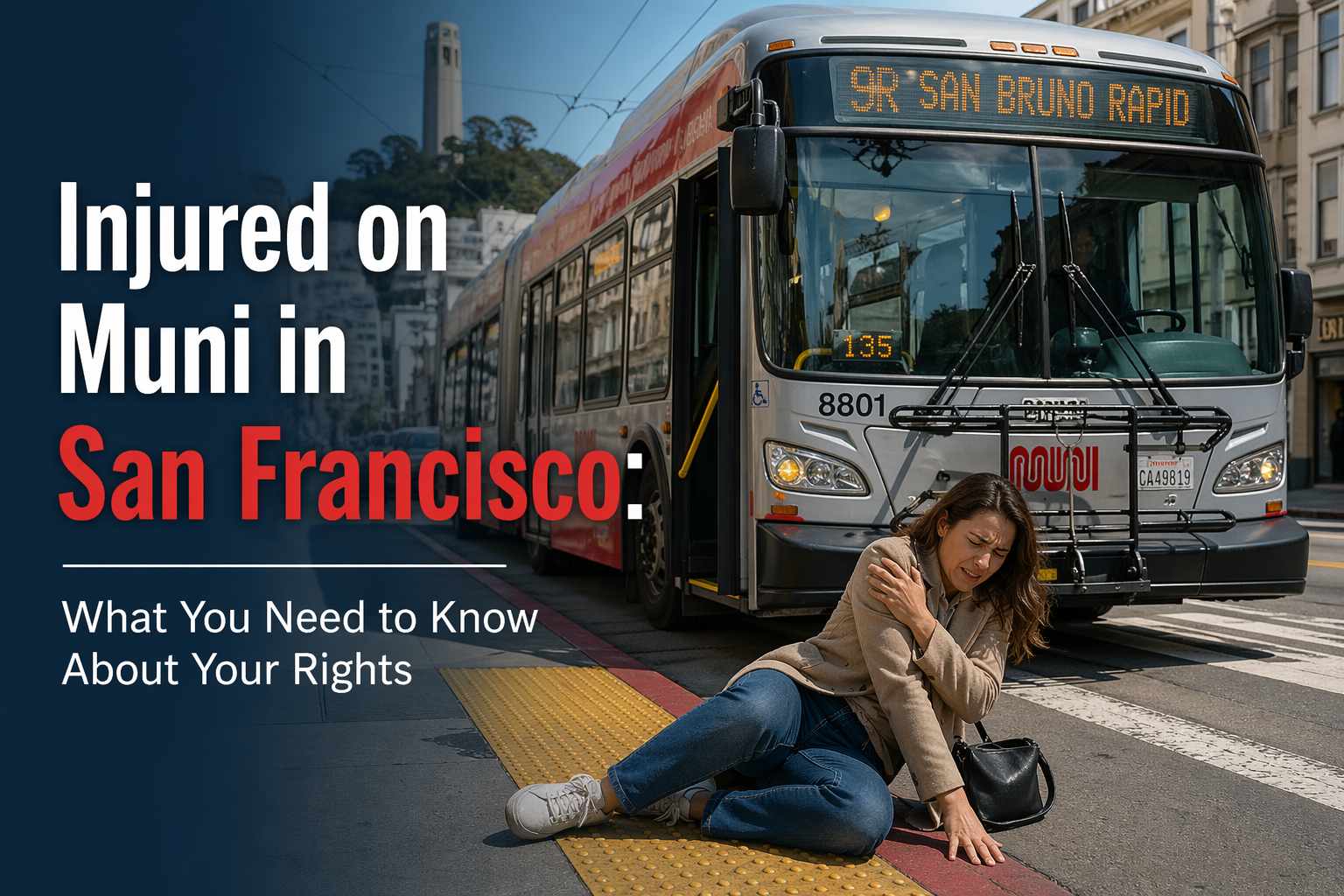
If you were injured on Muni in San Francisco, do not assume your case works like a normal car accident claim. Muni is part of the San Francisco Municipal Transportation Agency, and claims involving Muni can trigger California’s government-claim rules, which usually move much faster than the standard two-year personal injury deadline. Muni includes buses, light rail Metro trains, historic streetcars, and cable cars, so the same timing issue can come up in many different transit injuries.
That timing issue matters. In many Muni injury cases, you may need to present a government claim within six months of the injury, before you can file a lawsuit for money damages. If that deadline is missed, a valid case can become much harder to pursue.
Below, we explain the main deadlines, the evidence that often matters most, and who may be legally responsible after a Muni injury in San Francisco. This article is general information, not legal advice for any particular case.
Why Muni cases are different
Most private-party injury cases in California are measured against the ordinary two-year personal injury statute of limitations. California Courts explains that personal injury claims are usually due within two years of the injury. But when the defendant is a government agency, the deadlines are different and the injured person usually must first submit a claim to the agency by an earlier deadline.
That is why a Muni injury case deserves immediate attention. If the event involves a Muni bus, train, cable car, streetcar, station condition, boarding area, or Muni employee acting within the scope of employment, you should evaluate the government-claim issue right away instead of waiting to see how you feel months later.
The main deadline after a Muni injury
For claims involving injury to a person, California’s Government Claims Act generally requires a claim to be presented no later than six months after accrual. California Courts states the rule plainly: for injury claims against a government agency, send the claim by the deadline, which is generally six months from the injury. The statute itself says a claim for death or injury to a person must be presented not later than six months after accrual.
For San Francisco claims against the City and County of San Francisco, the City Attorney’s claims page says claim forms are required under Government Code sections 905 and 915. As of the time of this blog post, the original completed claim form must be filed in person or by mail with the Controller’s Office Claims Division at 1390 Market Street, 7th Floor, San Francisco, CA 94102-5408. However, you should verify the correct contact information on your own.
In practical terms, that means many injured Muni riders, pedestrians, cyclists, drivers, or workers cannot safely rely on the regular two-year deadline alone. The safer approach is to assume the six-month government-claim deadline may apply and analyze the case immediately.
What happens after the claim is filed
California Courts says the government generally has 45 days to respond to the claim. If the claim is denied, you generally have six months from the date the rejection was mailed to file suit. If the government does not respond within that time, California Courts says you generally have up to two years from the injury date to start the case. Government Code section 945.6 says the same basic thing: if written notice is given, suit must be filed no later than six months after delivery or mailing; if written notice is not given, the suit may be filed within two years from accrual.
This is one reason Muni cases can be deadline traps. A person may think, “I still have plenty of time because California gives me two years,” but government claims often require action much earlier.
What if the six-month deadline was missed?
Missing the initial deadline does not always end the analysis, but it is dangerous. Government Code section 911.4 allows a written application for leave to present a late claim when a claim that should have been presented within six months was not timely presented. The statute says that application must be made within a reasonable time not to exceed one year after accrual, and it must state the reason for the delay.
That is not something to handle casually. The late-claim process is technical, and waiting longer can make the problem worse.
Common ways people get hurt on Muni
Muni injury cases are not limited to big crashes. People are often injured when a bus stops suddenly, a train jerks before a rider is seated, a rider falls while boarding or exiting, a door closes on a passenger, a bus collides with another vehicle, or a dangerous condition at a station, platform, stop, or walkway causes a fall. Because Muni operates buses, Metro trains, historic streetcars, and cable cars throughout San Francisco, the mechanism of injury can vary a lot from case to case.
Who may be liable after a Muni injury?
1. The public entity responsible for Muni operations
A central question is whether the City and County of San Francisco, through SFMTA and Muni, may be legally responsible. Government Code section 815.2 says a public entity is liable for injury proximately caused by an act or omission of its employee within the scope of employment if the act or omission would otherwise have created a claim against that employee. That is the basic statute behind many negligence claims involving public employees.
So if the facts show that a Muni operator drove negligently, failed to keep a proper lookout, started moving before a rider was safe, closed doors unsafely, or otherwise acted negligently within the scope of the job, the public entity may face liability under section 815.2. Whether that can be proven depends on the evidence.
2. The public entity for a dangerous condition of public property
Some Muni cases are not really about bad driving. They are about unsafe property conditions. Government Code section 835 allows liability against a public entity for injury caused by a dangerous condition of its property if the plaintiff shows the property was in a dangerous condition at the time of injury, the condition proximately caused the injury, the condition created a reasonably foreseeable risk of that kind of injury, and either an employee created the condition or the entity had actual or constructive notice of it in time to protect against it.
That statute may matter in cases involving unsafe platforms, damaged pavement near stops, broken station features, hazardous boarding surfaces, visibility problems, or other transit-property defects. Again, the exact facts matter.
3. A non-government person or company
Not every Muni case is purely a claim against the City. California Courts notes that in personal injury cases, it is not always clear who is responsible, and people often sue the person who caused the injury, the owner of the car or property, or an employer if the person was working at the time. In a Muni case, depending on the facts, there may also be claims against a third-party driver, a property owner, or another non-government defendant in addition to any government claim.
For example, a private driver may strike a Muni bus, force the operator into an emergency maneuver, hit a rider in a crosswalk near a stop, or collide with your vehicle while a Muni vehicle is involved in the chain of events. Those facts can change who is liable and whether more than one claim must be pursued.
Evidence that can make or break a Muni injury case
Evidence disappears fast in transit cases. California Courts recommends keeping evidence such as photos of the scene or injuries, medical bills or doctor reports, witness statements, and police reports. That advice is especially important in a Muni case because a short government-claim deadline and quickly changing transit conditions can make later reconstruction harder.
Get the basic transit details immediately
Try to identify the Muni line, vehicle number, direction of travel, nearest intersection, time of incident, and whether the event involved a bus, Metro train, cable car, or streetcar. Muni runs many vehicle types across San Francisco, so specificity matters.
Photograph the scene early
Take photos of the vehicle, location, boarding area, gaps, tracks, curb, platform, signage, weather, skid marks, body position, damaged belongings, and visible injuries. If you cannot do it yourself, ask someone to do it for you. California Courts specifically lists photos as key evidence in injury cases.
Get witnesses before they disappear
Witness names and contact information can be critical in sudden-stop or boarding-and-exiting cases. Many transit injuries happen in seconds, and the dispute later becomes whether the movement was ordinary or unusually violent, whether the operator saw the rider, or whether a dangerous condition had been there long enough to matter. California Courts lists witness statements as important evidence to keep.
Seek medical care and document symptoms
Prompt medical care helps protect your health and helps create a record connecting the incident to the injury. Medical records, bills, and doctor reports are all part of the evidence California Courts highlights for injury cases.
Move quickly to preserve video
SFMTA has publicly said it uses high-quality video cameras throughout the system and that each bus is equipped with at least 11 cameras recording whenever the bus is running. Its surveillance technology policy also states that mobile video recorders are used in buses and trains to record footage from inside and outside the vehicle. That means video may exist, but you should not assume it will be saved forever.
Consider a public records request, but do not confuse that with a claim
SFMTA has a public records request process and says requests are handled under the Sunshine Ordinance and the California Public Records Act. The agency says it is generally allowed 10 calendar days to respond, with a possible additional 14-day extension in some circumstances. Public records can be useful for documents, videos, and other materials, but a public-records request is not a substitute for a government claim. The claim deadline is its own issue.
What should an injured person do right away?
After a Muni injury, the practical first steps are usually these: get medical care, identify the exact Muni vehicle and location, gather witnesses, photograph everything, preserve damaged items, request available reports, and evaluate the government-claim deadline immediately. If there is any chance the City or SFMTA may be involved, treat the six-month deadline as urgent.
Why these cases often need an early investigation
The hardest part of many Muni cases is not just proving injury. It is identifying the correct defendant, complying with the claims statute, and locking down evidence before it disappears. Government claims have their own deadlines. SFMTA may hold records. Transit video may matter. And more than one party may share blame.
Contact Anderson Franco Law
If you were injured on Muni in San Francisco, do not treat it like an ordinary private car accident. Consider speaking with a San Francisco injury law firm to discuss your claim. This is particularly true if your claim was rejected. The sooner the case is evaluated, the better the chance of protecting both the deadline and the evidence.
Get in Touch
Fill out the contact form or call us at (415) 727-1832 to schedule your free consultation.


Contact Us Now For a Free Case Evaluation
Our Locations

Suite 400
San Francisco, CA 94105

San Rafael, CA 94903

Suite 118
Greenbrae, CA 94904