






Dangerous Road Conditions in California: When Can You Sue a Public Entity?


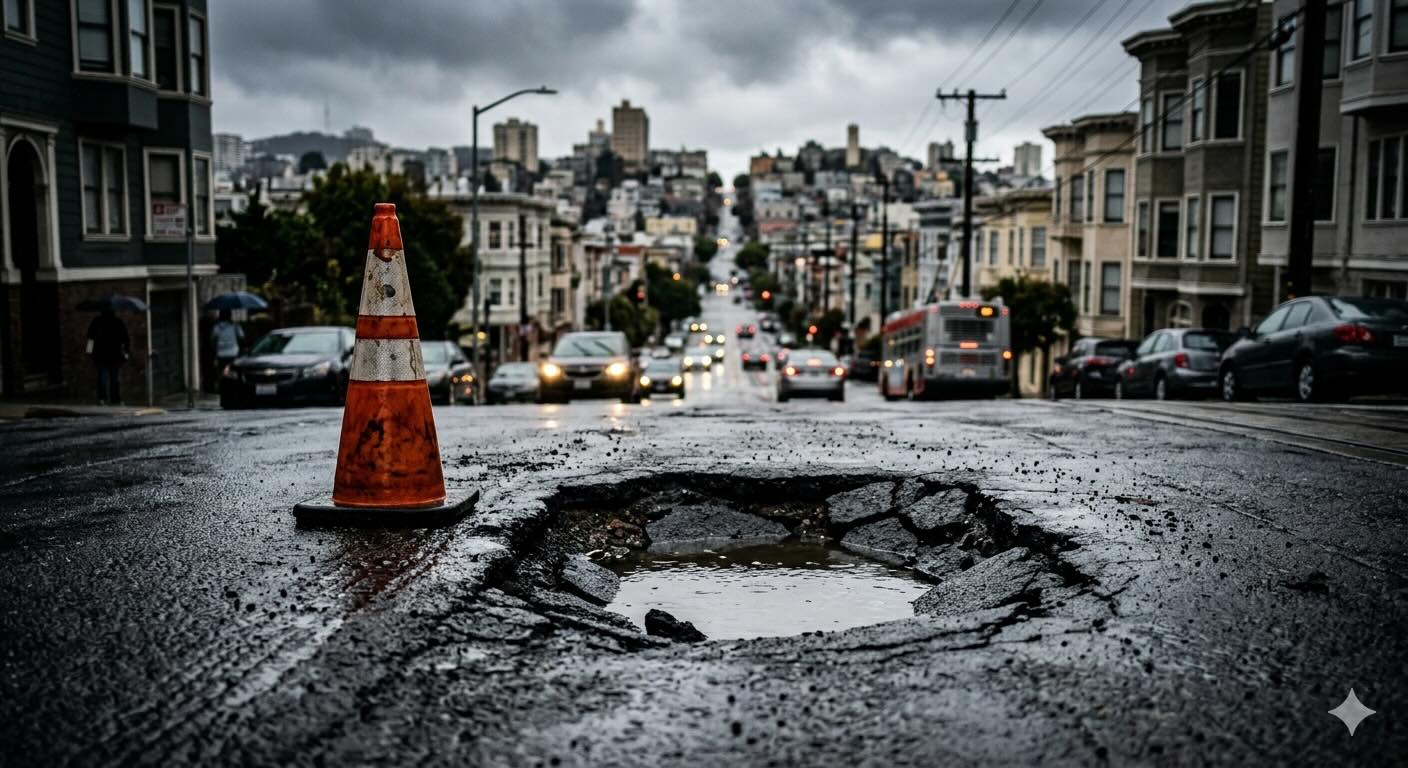
A pothole, unsafe intersection, defective roadway, or poorly maintained highway can cause a serious crash even when every driver involved is trying to be careful. For bicyclists and motorcyclists, a roadway defect that appears relatively minor to someone in a car can be enough to cause a devastating collision.
These cases arise throughout the Bay Area. A crash may involve Highway 101 in Marin County, the Richmond-San Rafael Bridge, a busy San Francisco intersection, a bicycle route, or a neighborhood street maintained by a city or county.
When the roadway itself contributes to an accident, the government agency responsible for the property may sometimes be held liable. But claims against public entities are different from ordinary personal injury claims. California law imposes special liability rules, government immunities, and unusually short claim-presentation deadlines.
If you were seriously injured because of a dangerous roadway condition, identifying the responsible public entity and preserving evidence quickly can be critical.
Can You Sue the Government for a Dangerous Road Condition in California?
Yes. You may be able to sue a government entity for a dangerous road condition in California when the requirements of Government Code section 835 are satisfied.
California Government Code section 835 permits liability when public property was in a dangerous condition, the condition caused the injury, the condition created a reasonably foreseeable risk of the type of injury that occurred, and either a public employee created the condition or the public entity had sufficient actual or constructive notice of it to take protective measures.
That means a serious accident on a government-owned road does not automatically make the government responsible. The evidence must connect the condition of the public property to the crash and establish one of the statutory bases for liability.
The responsible entity also depends on the location. A case may involve the State of California and Caltrans, a city, a county, or another public agency. For example, Caltrans operates California’s state highway system, including the Richmond-San Rafael Bridge, and is currently performing roadway maintenance work on portions of U.S. 101 in Marin County.
Determining who actually owned or controlled the property is therefore one of the first steps in investigating a dangerous-roadway case.
What Is a “Dangerous Condition” of Public Property?
California law does not treat every crack, bump, pothole, or imperfect road as legally dangerous.
Government Code section 830 defines a dangerous condition as a condition that creates a substantial—as opposed to minor, trivial, or insignificant—risk of injury when the property is used with due care in a reasonably foreseeable manner.
Whether a roadway meets that standard depends heavily on the facts.
A shallow pavement defect on an otherwise straight, visible road may present a very different case from a deep pothole located in a bicycle lane where riders have little ability to avoid it. Similarly, an intersection design may become particularly dangerous because of sight-distance limitations, changing traffic volumes, roadway geometry, or other surrounding conditions.
Examples of Dangerous Road Conditions
Potentially dangerous road conditions can include:
- large potholes or severely deteriorated pavement;
- abrupt pavement height changes or unsafe roadway transitions;
- dangerous shoulders or pavement edges;
- defective or damaged guardrails;
- roadway debris that has not been addressed;
- unsafe drainage conditions or recurring roadway flooding;
- vegetation or physical obstructions that severely restrict sight distance;
- dangerous curves or intersection configurations;
- defects in bicycle lanes or paths;
- unsafe construction zones or roadway work;
- malfunctioning equipment or other conditions affecting the safe movement of traffic; and
- roadway designs that have become dangerous because surrounding physical conditions have changed.
Whether any particular condition creates public-entity liability requires a case-specific analysis.
For example, Anderson Franco Law’s San Francisco bicycle accident practice addresses crashes involving potholes, roadway defects, failed maintenance, dangerous transitions, and public-entity design issues because these conditions can be particularly dangerous for cyclists.
What If the Government Knew About the Dangerous Road?
Notice is often one of the most important issues in a dangerous-road-condition case.
Under Government Code section 835, a plaintiff may establish liability by showing that a public employee negligently or wrongfully created the dangerous condition. Alternatively, the plaintiff may show that the government had actual or constructive notice of the dangerous condition sufficiently before the accident to take reasonable protective measures.
Actual Notice
Actual notice may exist when the government received information directly identifying the hazard.
Depending on the case, evidence might include earlier complaints from residents, 311 reports, maintenance requests, prior accident reports, communications between government employees, inspection reports, or previous attempts to repair the same condition.
Constructive Notice
A public agency does not necessarily need to admit that it knew about the hazard.
Constructive notice may become an issue when a dangerous condition existed for enough time, and was sufficiently apparent, that a reasonable inspection system should have discovered it.
This is one reason photographs taken immediately after an accident can be so important. A roadway may be repaired shortly afterward, eliminating some of the most persuasive physical evidence showing how long the condition had existed.
What Evidence Can Prove a Dangerous Road Condition?
Dangerous-roadway cases frequently require considerably more investigation than an ordinary two-car accident.
The investigation may include photographs and video of the roadway, measurements, maintenance records, inspection documents, prior complaints, work orders, roadway plans, construction documents, traffic studies, collision history, public records, witness testimony, and expert analysis.
In some cases, records showing earlier accidents involving the same location may help establish that a dangerous condition had developed or that the government had reason to investigate it.
The exact evidence depends on the theory of liability. A pothole case, for example, may turn heavily on maintenance and inspection history. A roadway-design case may require engineering plans, approval records, traffic data, and expert testimony.
Can You Sue Because a Traffic Sign or Signal Was Missing?
Sometimes—but a missing sign or traffic control device does not automatically establish government liability.
California provides public entities significant protection for decisions involving traffic signals, signs, markings, and warning devices. Government Code section 830.4 provides that property is not considered dangerous merely because certain traffic controls were not installed. Government Code section 830.8 also establishes protections relating to warning devices.
There is an important limitation, however. California law recognizes circumstances in which a warning may be necessary because an existing dangerous condition would not reasonably be apparent or anticipated by a person exercising due care—the concept sometimes called a “concealed trap.”
The California Supreme Court has confirmed that this failure-to-warn analysis can remain relevant even where roadway design immunity is also disputed.
As a result, a claim involving an allegedly missing warning sign requires more analysis than simply showing that another sign might have made the road safer.
What Is Design Immunity?
Government agencies frequently raise “design immunity” in cases alleging that a highway, intersection, bicycle facility, median, guardrail system, or other public improvement was defectively designed.
Government Code section 830.6 protects a public entity from certain claims arising from an approved plan or design when the statutory requirements for design immunity are satisfied.
In practical terms, courts generally will not allow a plaintiff to impose liability merely because an expert believes the government should have selected a different reasonable design after the fact.
But design immunity does not necessarily last forever.
The California Supreme Court has explained that design immunity can be lost under appropriate circumstances when changed physical conditions cause an originally approved design to become dangerous, the government has actual or constructive notice of the resulting dangerous condition, and the government has had a reasonable opportunity to address the problem or provide appropriate warnings.
This can become important on older roads where traffic volumes, surrounding development, vehicle patterns, pedestrian activity, bicycle traffic, or other physical conditions have materially changed since the original design was approved.
How Long Do You Have to File a Government Claim in California?
The deadline for claims against public entities is one of the most important differences between government cases and ordinary personal injury claims.
For claims involving personal injury or death, California Government Code section 911.2 generally requires the claimant to present a written government claim no later than six months after the claim accrues.
This is not the same as simply filing a lawsuit within the ordinary personal injury statute of limitations. The government-claim procedure generally must be addressed first.
What Happens After the Government Claim Is Filed?
Under Government Code section 912.4, a public entity generally has 45 days to act on a properly presented claim unless the period is extended by agreement. If the entity does not act during the applicable period, the claim is generally deemed rejected.
What happens next depends in part on how the rejection occurs.
If the government provides a written rejection notice that complies with Government Code section 913, Government Code section 945.6 generally requires the lawsuit to be filed within six months after that notice is personally delivered or deposited in the mail. If the required written notice is not provided, the statute provides a different limitations period that can extend to two years from accrual.
Because these rules depend on the claim, the response, and the form of notice received, calculating deadlines should be done carefully rather than relying on a general online statute-of-limitations calculator.
What If You Missed the Six-Month Government Claim Deadline?
Missing six months does not necessarily mean that every possibility for recovery immediately disappears.
California Government Code section 911.4 permits a person who missed the initial six-month presentation period to apply for permission to present a late claim in certain circumstances. That application generally must be made within a reasonable time not exceeding one year after accrual.
If the public entity denies an application for leave to present a late claim, California law also provides a procedure for asking a court for relief in qualifying circumstances. Government Code section 946.6 governs that process and imposes additional requirements and deadlines.
Late-claim relief is not automatic. Anyone who believes a government deadline may have been missed should therefore obtain legal advice promptly rather than assuming the case is either saved or lost.
Who Can Be Responsible for a Dangerous Road Accident?
One of the biggest mistakes in these cases is assuming that the agency whose name appears closest to the accident necessarily controlled the dangerous condition.
A roadway may involve different government agencies responsible for the roadway surface, traffic controls, construction, maintenance, drainage, adjoining property, or other infrastructure.
Private companies can sometimes be involved as well. A dangerous condition may have resulted from construction performed by a contractor, utility work, private development, or another party’s conduct.
A thorough investigation should determine who owned or controlled the property and whether another person or entity contributed to the accident.
What Compensation Is Available After a Dangerous Road Accident?
When liability is established, an injured person may be able to pursue compensation for losses caused by the accident. Depending on the circumstances, damages may include medical expenses, future medical care, lost earnings, reduced earning capacity, pain, suffering, emotional distress, physical limitations, disfigurement, and other legally recoverable losses.
Serious roadway crashes can cause traumatic brain injuries, spinal injuries, fractures, surgeries, permanent mobility limitations, scarring, and other long-term consequences. The value of a claim depends on the evidence, injuries, liability issues, available defendants, applicable defenses, and the effect of the injuries on the person’s life.
Why Early Investigation Matters in a Dangerous Road Case
Roadway evidence can change quickly.
A pothole can be filled. Vegetation can be trimmed. Signs can be replaced. Construction equipment can disappear. Lane markings can change. Surveillance footage can be overwritten. Witnesses can become difficult to locate.
At the same time, the six-month government-claim period may already be running.
Early investigation gives an attorney an opportunity to document the condition, determine which agency controlled the property, preserve evidence, request relevant government records, investigate prior complaints and accidents, and evaluate potential immunity defenses.
Why Choose Anderson Franco Law for a Dangerous Road Condition Case?
Dangerous-public-property cases combine personal injury law with a specialized body of California government-liability law.
Anderson Franco Law represents injured people throughout San Francisco, Marin County, and the greater Bay Area. Before representing injured plaintiffs, Anderson Franco represented insurance companies and defended injury claims. He now uses that experience to evaluate liability issues, anticipate defenses, and prepare serious injury claims from the perspective of how the opposing side is likely to analyze them.
Clients also work directly with Anderson Franco rather than having their cases primarily managed by a non-attorney case manager.
A dangerous-roadway case may require investigating public records, roadway maintenance history, prior complaints, design documents, accident history, government immunities, and applicable claim deadlines. The goal is to identify the strongest liability theory supported by the evidence and pursue the compensation available under California law.
Frequently Asked Questions About Dangerous Road Conditions
Can I sue Caltrans for a pothole accident?
You may be able to sue Caltrans for a pothole accident if Caltrans owned or controlled the roadway and the requirements for dangerous-condition liability under California law can be established. The existence of a pothole by itself is not enough; issues such as the severity of the defect, causation, how the condition developed, and whether Caltrans created it or had sufficient notice can be important.
Can a bicyclist sue over a pothole?
A bicyclist may have a claim over a pothole when the roadway defect constituted a dangerous condition of public property and the other statutory requirements are satisfied. Roadway defects can present particularly serious risks to bicyclists because a relatively small pavement defect can destabilize a bicycle and cause the rider to be thrown onto the roadway.
Can I sue because an intersection was poorly designed?
You may be able to pursue a claim involving a poorly designed intersection, but roadway-design cases often involve California’s design-immunity defense. The original approval of the design, the evidence supporting its reasonableness, subsequent changes in physical conditions, accident history, and the government’s notice of later hazards may all become important.
Is the deadline really only six months?
For many personal injury and wrongful death claims against California public entities, the government claim generally must be presented within six months after the cause of action accrues. That is why government involvement should be investigated as early as possible.
What should I do after an accident caused by a dangerous road?
After an accident caused by a potentially dangerous road, obtain appropriate medical treatment and preserve as much evidence as possible. Photographs and video showing the exact roadway condition and its surroundings can become especially important because the government may repair or alter the location soon afterward. You should also consider speaking with an attorney promptly because public-entity claims can involve substantially shorter deadlines than ordinary personal injury cases.
Talk to a California Dangerous Road Condition Lawyer
If a pothole, defective roadway, unsafe intersection, dangerous bicycle lane, highway design, or other condition of public property contributed to your injuries, Anderson Franco Law can evaluate what happened and determine whether a government entity or another party may be legally responsible.
Anderson Franco Law represents injured clients in San Francisco, Marin County, and throughout the Bay Area. Consultations are free, and Anderson Franco works directly with clients whose cases the firm accepts.
Call or text 415-727-1832 to discuss your case.
Disclaimer: This article provides general information about California law and is not legal advice. Government liability is highly fact-specific, and different statutes, exceptions, immunities, and deadlines may apply depending on the circumstances. Reading this article does not create an attorney-client relationship.
Get in Touch
Fill out the contact form or call us at (415) 727-1832 to schedule your free consultation.


Contact Us Now For a Free Case Evaluation
Our Locations

Suite 400
San Francisco, CA 94105

San Rafael, CA 94903

Suite 118
Greenbrae, CA 94904