







What Is a Policy Limits Demand in a California Injury Case?


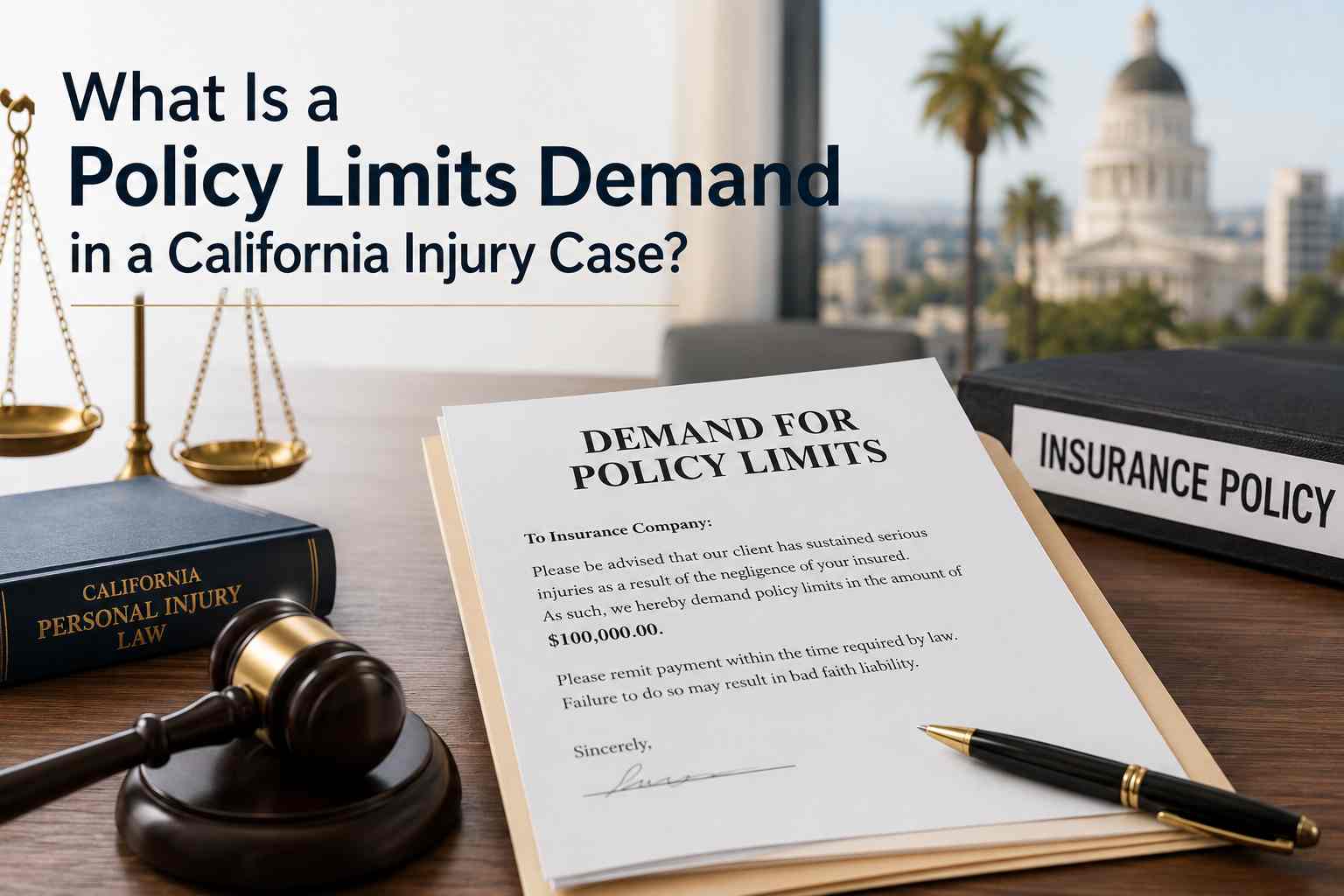
After a serious accident, the insurance coverage may become just as important as the facts of the crash. An injured person may have strong evidence, serious injuries, and large medical bills. But if the at-fault person has limited insurance, the case may depend on how much coverage is available. You want to know how to make a policy limit demand in California.
A policy limits demand is a settlement demand asking the insurance company to pay the available insurance policy limits to resolve an injury claim. In simple terms, it tells the insurance company: your insured caused serious harm, the claim is worth at least the available coverage, and you should pay the policy limits now to settle the case.
Policy limits demands are common in California car accident, pedestrian accident, motorcycle accident, truck accident, premises liability, and wrongful death cases. They are especially important when the injuries are serious and the at-fault party may not have enough insurance to fully cover the harm.
At Anderson Franco Law, we handle personal injury cases throughout San Francisco and the Bay Area. We also understand how insurance companies evaluate these demands because our attorney has experience handling cases from the insurance defense side.
What Are Insurance Policy Limits?
Insurance policy limits are the maximum amount an insurance company may pay under a particular policy for a covered claim.
For example, in a California car accident case, an at-fault driver may have bodily injury liability coverage. That coverage may have limits such as: $30,000 per person and $60,000 per accident.
That means the insurance company may pay up to $30,000 for one injured person, and up to $60,000 total if multiple people were injured in the same crash.
California’s current minimum auto liability limits for standard policies are $30,000 for injury or death to one person, $60,000 for injury or death to more than one person, and $15,000 for property damage.
Those are only minimum limits. Some drivers, businesses, property owners, and companies carry higher limits. There may also be umbrella coverage, excess coverage, employer coverage, commercial vehicle coverage, rideshare coverage, or uninsured/underinsured motorist coverage.
That is why identifying all available insurance is one of the most important early steps in a serious injury case.
What Is a Policy Limits Demand?
A policy limits demand is a formal settlement offer asking the insurance company to pay the available policy limits.
The demand usually explains:
- How the accident happened
- Why the insured person or business is legally responsible
- What injuries the claimant suffered
- What medical care the claimant received
- What the known medical bills are
- Whether the claimant lost wages or income
- How the injuries affected the claimant’s life
- Why the value of the claim meets or exceeds the insurance limits
- What the insurance company must do to accept the demand
In a serious case, the policy limits demand may be one of the most important documents sent before a lawsuit is filed.
It is not just a request for money. It is a legal and strategic communication. If written correctly, it gives the insurance company a fair chance to resolve the case within the available coverage. If the insurance company refuses a reasonable demand, that refusal may later become important.
Is a Policy Limits Demand the Same as a Regular Demand Letter?
No. A regular injury demand letter asks for a settlement amount. A policy limits demand specifically asks for the insurance policy limits.
A regular demand might say:
“We demand $250,000 to resolve this claim.”
A policy limits demand might say:
“We demand payment of all available bodily injury liability policy limits to resolve this claim.”
The difference matters.
A policy limits demand is usually used when the injured person’s damages likely exceed the available insurance. For example, if someone suffers a traumatic brain injury, spinal injury, surgery, permanent disability, or death, a low-limit policy may not be enough. In that situation, the injured person may demand the available limits instead of continuing long negotiations.
What Is a Time-Limited Demand Under California Law?
In California, many pre-lawsuit policy limits demands are governed by Code of Civil Procedure sections 999 through 999.5.
A “time-limited demand” generally means a pre-lawsuit offer to settle a personal injury, bodily injury, property damage, or wrongful death claim within the available liability insurance limits, where the offer must be accepted within a specific time. California defines “extracontractual damages” as damages exceeding the available liability insurance limits.
This matters because California law now sets rules for many time-limited demands sent by represented claimants before a lawsuit or arbitration demand is filed.
Under California Code of Civil Procedure section 999.1, a time-limited demand must be in writing, labeled as a time-limited demand or reference the statute, and include specific material terms. The acceptance period must generally be at least 30 days if sent by email, fax, or certified mail, and at least 33 days if sent by mail.
The statute also requires the demand to include a clear offer to settle within policy limits, an offer for a complete release, the date and location of the loss, the claim number if known, a description of known injuries, and reasonable proof such as medical records or bills when applicable.
What Types of Cases Does California’s Time-Limited Demand Law Cover?
California’s time-limited demand statute does not apply to every type of case.
Under Code of Civil Procedure section 999.5, the chapter applies to claims covered under automobile, motor vehicle, homeowner, or commercial premises liability insurance policies for property damage, personal injury, bodily injury, and wrongful death claims. It applies to time-limited demands transmitted on or after January 1, 2023.
That means the statute often applies to cases such as:
- Car accidents
- Truck accidents
- Motorcycle accidents
- Pedestrian accidents
- Bicycle accidents
- Commercial vehicle accidents
- Homeowner liability claims
- Premises liability claims
- Serious injury claims
- Wrongful death claims
The statute is especially relevant when a lawyer sends a pre-lawsuit demand with a deadline.
Why Do Injury Lawyers Send Policy Limits Demands?
Injury lawyers send policy limits demands for several reasons.
First, the demand may help resolve a serious case early. If liability is clear and the injuries are severe, the insurance company may recognize that the claim is worth more than the available coverage. Paying the policy limits may protect its insured from further exposure.
Second, the demand may force the insurance company to evaluate the claim seriously. Insurance companies often delay, request more documents, or minimize injuries. A well-supported policy limits demand puts the evidence in front of the carrier and asks for a clear decision.
Third, the demand may create a record. If the insurance company refuses to settle within policy limits when it reasonably should have done so, that refusal may later matter in a bad faith or excess judgment analysis.
California’s civil jury instructions define “policy limits” as the highest amount of insurance coverage available under the policy for the claim against the insured. They also explain that a settlement demand within policy limits may be reasonable when the insurer knew or should have known that a potential judgment was likely to exceed the demand based on the claimant’s injuries, losses, and the insured’s probable liability.
When Is a Policy Limits Demand Appropriate?
A policy limits demand may be appropriate when the injured person’s damages are likely equal to or greater than the available insurance.
That can happen when the case involves:
- Surgery
- Fractures
- Brain injuries
- Spinal injuries
- Herniated discs with serious symptoms
- Permanent disability
- Major scarring
- Burn injuries
- Loss of income
- Future medical care
- Death
- Clear liability
- Low insurance limits
A policy limits demand may also make sense when the known medical bills already approach or exceed the available coverage.
For example, if a driver with a $30,000 bodily injury policy causes a crash that requires surgery, the injured person’s claim may clearly exceed the policy. In that situation, a policy limits demand may be the most direct way to resolve the claim.
But not every case should start with a policy limits demand. If liability is unclear, treatment is incomplete, damages are still developing, or coverage has not been confirmed, the timing may require more work.
What Should a California Policy Limits Demand Include?
A strong California policy limits demand should be clear, complete, and supported by evidence.
It should usually include the following:
Liability Facts
The demand should explain why the insured is responsible. In a car accident case, that may include unsafe speed, a red-light violation, an unsafe left turn, distracted driving, DUI, or failure to yield.
In a premises liability case, that may include unsafe property conditions, poor inspection practices, prior notice, code violations, or failure to fix a known danger.
Injury Summary
The demand should clearly describe the injuries. It should not just list diagnoses. It should explain what the injuries mean for the person’s life.
For example, a demand may discuss pain, mobility limits, sleep problems, missed work, medical restrictions, future care, and loss of normal activities.
Medical Records and Bills
The demand should include reasonable proof. In many cases, that means medical records, medical bills, imaging reports, surgical records, physical therapy records, and future care information.
California’s statute specifically allows reasonable proof to include medical records or bills when applicable.
Wage Loss or Income Loss
If the injured person missed work, the demand should include available wage loss documentation. That may include pay stubs, employer letters, tax records, disability notes, or self-employment records.
Lien and Reimbursement Issues
A policy limits demand should also address liens and reimbursement claims carefully. Health insurers, Medi-Cal, Medicare, workers’ compensation carriers, medical providers, and ERISA plans may claim reimbursement from a settlement.
California’s statute requires a clear offer to settle all claims within policy limits, including satisfaction of liens.
That does not mean lien issues are simple. They can be complicated, and they can affect the injured person’s net recovery.
Release Terms
The demand should explain what release is being offered. Under California Code of Civil Procedure section 999.1, the demand must include an offer for a complete release from the claimant for the insurer’s insureds from present and future liability for the occurrence.
Release language matters. A poorly worded demand may create disputes over whether the insurance company could accept it.
Deadline for Acceptance
If the demand is time-limited, the deadline must comply with California law when the statute applies. A represented claimant generally cannot give an insurer an unreasonably short deadline and expect the demand to carry the same legal effect under the statute.
Where Must the Policy Limits Demand Be Sent?
California law also addresses where certain time-limited demands must be sent.
Under Code of Civil Procedure section 999.2, the claimant must send the demand to the insurer’s designated email or physical address for time-limited demands if the insurer has provided one and the Department of Insurance has made it public, or to the insurance representative assigned to handle the claim if known.
The California Department of Insurance maintains information for insurer-designated addresses for time-limited demands.
This detail matters. A strong demand can lose force if it is sent to the wrong place or if there is no clear proof of transmission.
What Happens After a Policy Limits Demand Is Sent?
After a policy limits demand is sent, the insurance company may:
- Accept the demand
- Reject the demand
- Ask for more information
- Ask for clarification
- Ask for an extension
- Dispute liability
- Dispute damages
- Claim there is a coverage issue
- Offer less than the policy limits
Under California Code of Civil Procedure section 999.3, a recipient may accept a time-limited demand by written acceptance of the material terms. The statute also says that a request for clarification, additional information, or an extension does not, by itself, count as a counteroffer or rejection. If the insurer does not accept, it must notify the claimant in writing of its decision and the basis for that decision before the demand expires.
That written response can matter later. It may show whether the insurer had a valid reason for not accepting the demand.
Does the Insurance Company Have to Pay Policy Limits?
No. The insurance company does not automatically have to pay policy limits just because the injured person demands them.
The insurer may dispute liability, causation, damages, coverage, the amount of available insurance, or the terms of the demand.
But the insurance company must make a serious evaluation. If the claim is clearly worth more than the available policy limits and the insured faces a real risk of an excess judgment, refusing to settle may create risk for the insurer.
California bad faith law focuses heavily on whether the insurer acted reasonably. The California Court of Appeal in Pinto v. Farmers Insurance Exchange emphasized that a bad faith claim requires a finding that the insurer acted unreasonably in failing to accept the settlement offer.
That is why the details matter. The strength of the demand, the evidence provided, the deadline, the release terms, and the insurer’s response may all become important.
What Does “Bad Faith” Mean in This Context?
In this context, “bad faith” usually refers to an insurance company failing to act properly toward its own insured.
The injured person is usually not the insurance company’s customer. The at-fault person or business is the insured. The insurance company owes duties to that insured.
If the insurance company refuses a reasonable opportunity to settle within policy limits, and that refusal exposes the insured to a judgment above the policy limits, the insurer may face bad faith exposure.
The California Supreme Court has long recognized that an insurer should not put its own interests ahead of the insured’s interests when deciding whether to settle within policy limits. In Crisci v. Security Insurance Co., the court explained that an insurer should not reject an opportunity to settle within limits to protect its own interests unless it is willing to absorb the resulting loss.
For injury victims, the practical point is this: a strong policy limits demand can create pressure on the insurer to resolve the claim when the evidence justifies it.
Can a Policy Limits Demand Lead to More Than the Policy Limits?
Sometimes, but not automatically.
A policy limits demand asks for the available limits. If the insurer accepts, the case usually resolves for those limits, subject to the terms of the release and lien issues.
If the insurer refuses a reasonable demand and the case later results in a judgment above the policy limits, there may be further legal issues involving excess exposure and bad faith. But that is not guaranteed. The injured person must still prove the legal requirements.
A bad faith theory is not a shortcut. It depends on the facts, the demand, the insurer’s conduct, the insured’s exposure, and the later outcome.
Why Policy Limits Are Often Not Enough
Many injured people are surprised to learn how low insurance limits can be.
A person may suffer a life-changing injury, but the at-fault driver may only have minimum coverage. Even California’s increased minimum limits may be too low for serious injuries.
A single emergency room visit, ambulance bill, MRI, injection, surgery, or hospital stay can quickly exceed minimum coverage. Lost wages and future care can make the damages even larger.
That is why a personal injury lawyer should look beyond the first insurance policy.
There may be additional sources of recovery, such as:
- The vehicle owner’s policy
- The driver’s policy
- Employer coverage
- Commercial auto coverage
- Rideshare coverage
- Umbrella coverage
- Excess coverage
- Premises liability coverage
- Uninsured motorist coverage
- Underinsured motorist coverage
- Third-party defendants
Finding all available coverage can make a major difference in the result.
Policy Limits Demands in California Car Accident Cases
Policy limits demands are especially common in California car accident cases.
They may arise after:
- Rear-end collisions
- Left-turn crashes
- Intersection crashes
- Pedestrian crashes
- Bicycle crashes
- Motorcycle crashes
- Highway crashes
- Hit-and-run crashes
- Drunk driving crashes
- Distracted driving crashes
- Commercial vehicle crashes
- Rideshare crashes
- Delivery driver crashes
In a serious car accident case, the demand may include the traffic collision report, photos, medical records, bills, wage loss proof, witness statements, and a summary of why the other driver is responsible.
If the injured person’s damages clearly exceed the available bodily injury coverage, a policy limits demand may be appropriate.
Policy Limits Demands in Premises Liability Cases
Policy limits demands can also arise in premises liability cases.
These may include:
- Slip and fall injuries
- Trip and fall injuries
- Stairway falls
- Unsafe walkway injuries
- Apartment complex injuries
- Store injuries
- Bar and nightclub injuries
- Dog bite injuries
- Negligent security claims
In these cases, the demand must often prove more than the injury. It must show why the property owner, business, landlord, or other responsible party should be held liable.
That may require evidence of notice, inspection failures, prior complaints, unsafe conditions, poor lighting, broken flooring, missing warnings, inadequate security, or code violations.
Common Mistakes in Policy Limits Demands
Policy limits demands can be powerful. But they can also be mishandled.
Common mistakes include:
- Sending the demand too early
- Using an unclear deadline
- Failing to include enough medical proof
- Failing to identify all available insurance
- Failing to address liens
- Using vague release terms
- Demanding something outside policy limits
- Sending the demand to the wrong address
- Not confirming receipt
- Ignoring multiple claimants
- Overlooking umbrella or excess coverage
- Failing to explain why liability is clear
- Failing to explain why damages exceed the limits
A weak demand may give the insurance company reasons to delay or deny payment. A strong demand removes excuses.
Should You Send a Policy Limits Demand Without a Lawyer?
Usually, no.
An injured person can make a claim without a lawyer. But a policy limits demand can have major consequences. The wording, timing, proof, release terms, lien language, and delivery method all matter.
A demand that seems simple can create problems later. For example, the injured person may accidentally release claims too broadly, fail to protect a lien issue, miss another insurance policy, or settle for less than the case is worth.
If the injury is serious enough to consider a policy limits demand, it is usually serious enough to speak with a personal injury lawyer.
How Anderson Franco Law Approaches Policy Limits Demands
At Anderson Franco Law, we do not treat policy limits demands as generic letters.
We look at the case from several angles:
- What caused the injury?
- Who is legally responsible?
- What insurance policies may apply?
- Are there multiple insureds?
- Are there commercial policies?
- Is there umbrella or excess coverage?
- Are the injuries fully documented?
- Are future medical needs clear?
- Are liens or reimbursement claims involved?
- Is the demand being sent at the right time?
- Are the release terms clear?
- Is the insurer being given a fair chance to settle?
This approach matters because insurance companies look for weaknesses. They may argue that liability is unclear, treatment is unrelated, the deadline was improper, the proof was incomplete, the release was vague, or the demand did not comply with California law.
A well-prepared demand anticipates those arguments.
Talk to a California Personal Injury Lawyer
A policy limits demand can be one of the most important steps in a California injury case. It can lead to early settlement. It can also create pressure on the insurance company when the injuries are serious and the available coverage is too low.
But timing and wording matter. So does identifying all available insurance.
If you were seriously injured in San Francisco, Marin County, or elsewhere in the Bay Area, Anderson Franco Law can review your case, evaluate the available insurance, and determine whether a policy limits demand may be appropriate.
Call Anderson Franco Law for a free consultation.
No fee unless we recover.
Frequently Asked Questions About Policy Limits Demands
What is a policy limits demand in a California injury case?
A policy limits demand in a California injury case is a settlement demand asking the insurance company to pay the available insurance policy limits to resolve the claim. It is usually used when the injured person’s damages are likely worth as much as or more than the available insurance.
Does a policy limits demand mean the insurance company must pay?
A policy limits demand does not automatically mean the insurance company must pay. The insurer may still evaluate liability, injuries, damages, coverage, and the terms of the demand. However, if the demand is reasonable and the insurer refuses it without a proper basis, that refusal may create serious issues later.
How long does an insurance company have to respond to a California policy limits demand?
How long an insurance company has to respond depends on the demand. For many pre-lawsuit time-limited demands covered by California Code of Civil Procedure section 999.1, the demand must give at least 30 days to accept if sent by email, fax, or certified mail, and at least 33 days if sent by mail.
What proof should be included with a policy limits demand?
A policy limits demand should include reasonable proof supporting liability and damages. That may include medical records, medical bills, photos, police reports, witness statements, wage loss documents, imaging reports, surgical records, and other evidence showing why the claim is worth the available policy limits.
Can there be more than one insurance policy available?
There can be more than one insurance policy available in some injury cases. Depending on the facts, coverage may come from the driver, vehicle owner, employer, business, property owner, umbrella carrier, excess carrier, rideshare company, or the injured person’s own uninsured or underinsured motorist coverage.
Is a policy limits demand the same as accepting policy limits?
A policy limits demand is not the same as accepting policy limits. The demand is the offer. The insurance company must accept the material terms for a settlement to occur. The parties may still need to address releases, liens, payment, and dismissal terms.
Should I accept policy limits after a California accident?
You should not accept policy limits without understanding the full insurance picture, your injuries, your medical needs, your liens, and whether other coverage may apply. In some cases, policy limits may be fair. In other cases, accepting one policy too early may leave money on the table.
Can Anderson Franco Law help with a policy limits demand?
Anderson Franco Law can evaluate whether a policy limits demand makes sense in a California injury case. The firm reviews liability, damages, insurance coverage, liens, and strategy before deciding whether to send a demand.
Get in Touch
Fill out the contact form or call us at (415) 727-1832 to schedule your free consultation.


Contact Us Now For a Free Case Evaluation
Our Locations

Suite 400
San Francisco, CA 94105

San Rafael, CA 94903

Suite 118
Greenbrae, CA 94904