




Who Is at Fault in a Parking Lot Accident in California?


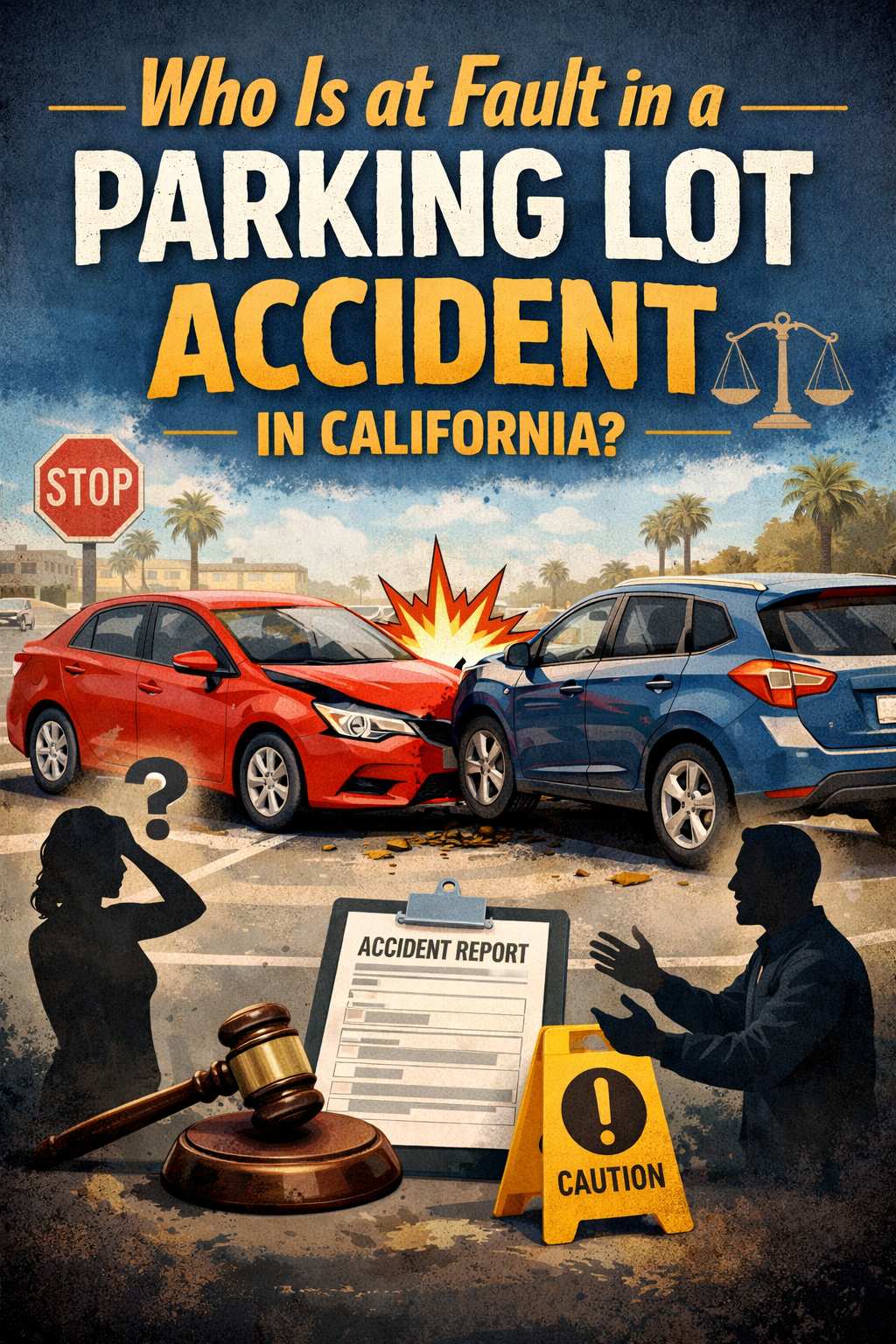
Most people don’t think of a parking lot as a high-risk location. You’re going slowly, there are no highway speeds, and everyone is just trying to get where they’re going. But the reality is that parking lots are the site of thousands of accidents every year in California — collisions between vehicles, cars striking pedestrians, and slip-and-falls caused by poor maintenance. When these accidents happen, one of the first — and most disputed — questions is: who is at fault?
The answer is almost never simple. California’s parking lot accident cases can involve multiple potentially liable parties: drivers who fail to yield, property owners who neglect dangerous conditions, and even a mix of both. Understanding how fault is assigned — and how California’s comparative fault rules apply — can mean the difference between recovering full compensation and walking away with nothing.
At Anderson Franco Law, we’ve represented clients injured in all types of parking lot accidents. In this post, we’ll break down how fault is determined, what rules apply, who can be held responsible, and what steps you should take if you’ve been injured.
Why Parking Lot Accidents Are Legally Complicated
Unlike accidents on public roads, parking lot accidents don’t always fit neatly into standard traffic law. Many parking lots are private property, which changes the legal landscape significantly. Here’s why these cases are more complex than they appear:
- Traffic signals and lane markings are often absent or unclear, leaving drivers to navigate by informal convention rather than enforceable rules of the road.
- Pedestrians and vehicles share the same space with no sidewalks or designated crosswalks in many lots, creating ambiguity about who has the right of way.
- Property owners may bear partial or full responsibility if the accident was caused or worsened by poor lighting, faded markings, dangerous pavement conditions, or inadequate traffic flow design.
- Multiple parties can share fault under California’s comparative negligence system, meaning liability can be split between a driver, a property owner, and even the injured person.
This complexity is exactly why speaking with an experienced California personal injury attorney matters — not just for litigation, but to ensure you even know who to pursue a claim against.
California’s Comparative Fault System and How It Applies to Parking Lots
California follows a pure comparative fault rule under California Civil Code § 1714. This means that even if you were partially at fault for a parking lot accident, you can still recover damages — but your recovery will be reduced by your percentage of fault.
Example: If you were 20% at fault for a parking lot collision and your total damages were $100,000, you could still recover $80,000 from the other parties.
In parking lot accidents, this is critically important because fault is rarely one-sided. A driver may have been speeding through the lot, but the property owner may have had a blind corner with no mirror or warning signage. An injured pedestrian may have been distracted, but a driver may have failed to check before reversing. California’s system allows each party’s contribution to be weighed and apportioned accordingly.
Common Parking Lot Accident Scenarios and How Fault Is Determined
1. Two Cars Backing Out at the Same Time
When two cars both reverse out of adjacent spaces simultaneously and collide, both drivers may share fault. Each driver has a duty to check their surroundings before and during reversing. Courts and insurance adjusters will look at:
- Which vehicle had begun moving first
- Whether either driver had a clear line of sight
- Whether either driver was exceeding a safe speed for reversing
In many of these cases, fault is split 50/50 — but that doesn’t mean you can’t recover. Under California’s comparative negligence rule, a 50% share of a $60,000 claim still yields $30,000 in compensation.
2. A Car Backing Out Hits a Car in the Thoroughfare Lane
Thoroughfare lanes — the main driving lanes that run through a parking lot — generally have the right of way over cars backing out of spaces. If a driver reverses out of a space and strikes a vehicle traveling in the thoroughfare lane, the reversing driver is typically at fault.
However, this isn’t absolute. If the thoroughfare driver was traveling at an unsafe speed, was distracted, or had the opportunity to avoid the collision and failed to do so, comparative fault may be assigned.
3. Failure to Yield at a Stop Sign or Intersection Within the Lot
Many parking lots have internal intersections with stop signs. When a driver runs a stop sign within a private parking lot and causes a collision, they can be found negligent even though private property traffic rules aren’t always governed by the Vehicle Code.
California courts have held that even on private property, drivers have a general duty of care to operate their vehicles safely. Ignoring marked traffic controls is strong evidence of negligence.
4. A Pedestrian Is Struck by a Vehicle in a Parking Lot
Pedestrians are among the most vulnerable — and frequently overlooked — victims in parking lot accidents.
In our experience, one of the most impactful cases we’ve handled involved a client who was crossing a parking lot on foot when he was struck by a vehicle. He sustained significant injuries, and the at-fault driver’s insurance initially disputed the severity and the liability. We were ultimately able to recover the driver’s full $100,000 policy limit on his behalf.
Cases like this illustrate a few important legal principles:
- Drivers owe a heightened duty of care to pedestrians, particularly in areas like parking lots where foot traffic is expected and predictable.
- The absence of a painted crosswalk does not eliminate pedestrian rights. In California, pedestrians crossing within a marked or even unmarked crosswalk area — including the paths between parked cars and store entrances — are entitled to reasonable protection.
- The property owner may also bear liability if poor lighting, obstructed sightlines, or the absence of pedestrian pathways contributed to the accident.
If you or a loved one was hit by a car in a parking lot, do not assume that the lack of a formal crosswalk means you don’t have a claim. Contact an attorney before speaking with any insurance company.
5. A Car Hits a Parked Vehicle and Leaves
If someone hits your parked car in a parking lot and leaves, this is a hit-and-run under California law, even in a private lot. You should:
- Document all available evidence (surveillance footage, witness accounts, paint transfer)
- File a police report immediately
- Notify your insurance company — if you have uninsured motorist (UM) coverage, it may apply to cover a hit-and-run even in a parking lot
An attorney can also help you pursue the at-fault driver if they are later identified, or maximize your uninsured motorist claim.
6. Slip, Trip, and Fall in a Parking Lot
Not all parking lot injuries involve moving vehicles. Premises liability claims arise when a person is injured due to a dangerous condition on the property — including in the parking lot. Common examples include:
- Cracked, uneven, or heaved asphalt
- Potholes that cause a person to trip and fall
- Inadequate lighting that causes a nighttime fall
- Unmarked curbs or elevation changes
- Water accumulation or pooling from poor drainage
- Faded pedestrian markings
Under California premises liability law, property owners owe a duty of care to inspect, maintain, and repair their property to keep it reasonably safe. If a dangerous condition existed, the owner knew or should have known about it, and it caused your injury, you may have a strong premises liability claim.
These claims are separate from vehicle accident claims but can be pursued simultaneously if both a driver and a property owner contributed to your injuries.
Who Can Be Held Liable in a California Parking Lot Accident?
One of the most important questions to answer early in any parking lot accident case is: who are the potentially responsible parties? In our experience, the list is often broader than clients initially expect.
The Driver of the At-Fault Vehicle
This is the most obvious liable party. Any driver who fails to exercise reasonable care — by speeding, failing to yield, reversing without checking, running internal stop signs, or failing to watch for pedestrians — can be held liable for resulting injuries and damages.
The Property Owner
If the parking lot itself was unsafe — poor lighting, obscured sightlines, missing signage, dangerous pavement, or a design that funnels pedestrians into vehicle paths — the property owner or manager may bear partial or full responsibility. This could be:
- A retail chain or shopping center
- A restaurant or entertainment venue
- An employer whose parking lot is provided for employees
- A municipal entity managing a public parking structure
Premises liability cases against property owners require showing that the dangerous condition existed, that the owner knew or had reason to know, and that they failed to take reasonable steps to fix it or warn visitors.
A Vehicle or Property Maintenance Company
If a third-party company was responsible for maintaining the parking lot — repaving, striping, lighting maintenance — and their negligence contributed to the accident, they too may be a proper defendant.
The Injured Person’s Own Employer
If the accident happened while the victim was in the course and scope of their employment (e.g., picking up supplies, making a delivery, traveling between work sites), workers’ compensation may apply in addition to a personal injury claim.
What Evidence Matters in a Parking Lot Accident Case?
Building a strong parking lot accident claim requires prompt and thorough evidence collection. Here is what matters most:
1. Surveillance Footage
Many parking lots — especially at shopping centers, pharmacies, and grocery stores — have extensive camera systems. This footage is often overwritten within 24 to 72 hours. An attorney can send a legal hold notice demanding preservation of this footage immediately.
2. Photographs of the Scene
Take photos of all vehicles, the exact location, road markings (or lack thereof), lighting conditions, signage, pavement conditions, skid marks, and any visible hazards. Time-stamp your photos.
3. Witness Information
Bystanders, other shoppers, or store employees may have seen what happened. Get names and contact information immediately — witnesses are often impossible to locate later.
4. The Police Report
Even in private parking lots, you can and should call law enforcement. A police report creates an official record and may contain important statements and an initial fault assessment.
5. Medical Records
Seek medical attention promptly — even if your injuries feel minor. Gaps in medical treatment are routinely used by insurance companies to argue that you weren’t seriously hurt or that your injuries were pre-existing.
6. Property Maintenance and Inspection Records
In premises liability cases, these records — including how recently the lot was inspected or repaved — are critical. They often need to be obtained through formal discovery.
California’s Statute of Limitations for Parking Lot Accidents
In California, the statute of limitations for most personal injury claims — including parking lot vehicle accidents and premises liability cases — is two years from the date of injury under California Code of Civil Procedure § 335.1.
However, there are important exceptions:
- Claims against a government entity (such as a city-owned parking lot or structure) must be filed as a government tort claim within six months of the incident under the California Government Claims Act.
- Minors generally have until two years after their 18th birthday to file.
- Discovery of latent injuries may toll the statute in limited circumstances.
Missing these deadlines can permanently bar your right to recover. Don’t wait — consult an attorney as soon as possible after an accident.
What Compensation Can You Recover?
If you’ve been injured in a parking lot accident in California, you may be entitled to recover:
- Medical expenses — past and future, including emergency care, surgery, physical therapy, and prescription costs
- Lost wages and lost earning capacity — if your injuries kept you from working or diminished your ability to earn in the future
- Pain and suffering — physical pain, emotional distress, and diminished quality of life
- Property damage — repair or replacement of your vehicle
- Loss of consortium — damages to your spouse or partner for the impact of your injuries on your relationship
In cases involving especially reckless or egregious conduct, punitive damages may also be available.
How Insurance Works in Parking Lot Accidents
Private lot, no traffic citation — does insurance still apply?
Yes. The absence of a police citation or clear traffic violation doesn’t eliminate a liability claim. California auto insurance — including liability coverage, collision coverage, and uninsured motorist coverage — applies in parking lot accidents just as it does on public roads.
What if the other driver disputes fault?
Insurance companies routinely dispute liability in parking lot accidents because the rules are less clear-cut than on public roads. They may offer a lowball settlement quickly, betting that you don’t know the full value of your claim or your legal rights. Do not accept any settlement offer without first speaking with an attorney.
What if the property owner’s insurer is involved?
Commercial general liability (CGL) policies held by property owners and businesses often cover premises liability claims. These claims are handled separately from the driver’s auto insurance but can be pursued simultaneously, particularly if both parties share responsibility for your injuries.
What to Do After a Parking Lot Accident in California
Here’s a practical checklist:
- Call 911 if anyone is injured — even in a private lot, emergency services and law enforcement should be notified.
- Stay at the scene — leaving after an accident involving injury or property damage is a crime.
- Exchange information with all involved drivers: name, license number, insurance information, vehicle registration.
- Document everything — photos, video, witness contact information, notes about the scene.
- Seek medical attention — go to an emergency room, urgent care, or your doctor as soon as possible.
- Notify your insurance company — but do not give a recorded statement or admit fault before consulting an attorney.
- Contact a personal injury attorney — especially before accepting any settlement offer.
Why Parking Lot Accident Cases Require an Experienced Attorney
These cases sit at the intersection of auto liability law, premises liability law, and insurance bad faith — all governed by California’s comparative fault rules. Without an attorney, you risk:
- Failing to identify all potentially liable parties (including the property owner)
- Accepting a settlement that doesn’t cover your future medical needs
- Missing a government claims deadline if a public entity is involved
- Having surveillance footage destroyed before it’s preserved
- Being assigned a disproportionate share of fault by an insurer trying to minimize its payout
We’ve seen clients come to us after settling for a fraction of what their case was worth — because they didn’t know a property owner shared liability, or because they accepted the first offer without understanding the full extent of their injuries.
Our team takes parking lot accident cases seriously because the injuries are real, the legal questions are genuinely complex, and the stakes for our clients are high.
Contact Anderson Franco Law — Free Consultation
If you or a loved one was injured in a parking lot accident in California — whether as a driver, passenger, or pedestrian — Anderson Franco Law is here to help. We offer free, no-obligation consultations, and we work on a contingency fee basis, which means you pay nothing unless we recover for you.
Don’t let the complexity of these cases discourage you from seeking the compensation you deserve.
📞 Call us today or use our online contact form to schedule your free consultation.
Anderson Franco Law represents injury victims throughout California, including victims of parking lot accidents, pedestrian accidents, and premises liability incidents. This blog post is for general informational purposes only and does not constitute legal advice. Reading this post does not create an attorney-client relationship.
Get in Touch
Fill out the contact form or call us at (415) 727-1832 to schedule your free consultation.


Contact Us Now For a Free Case Evaluation
Our Locations